

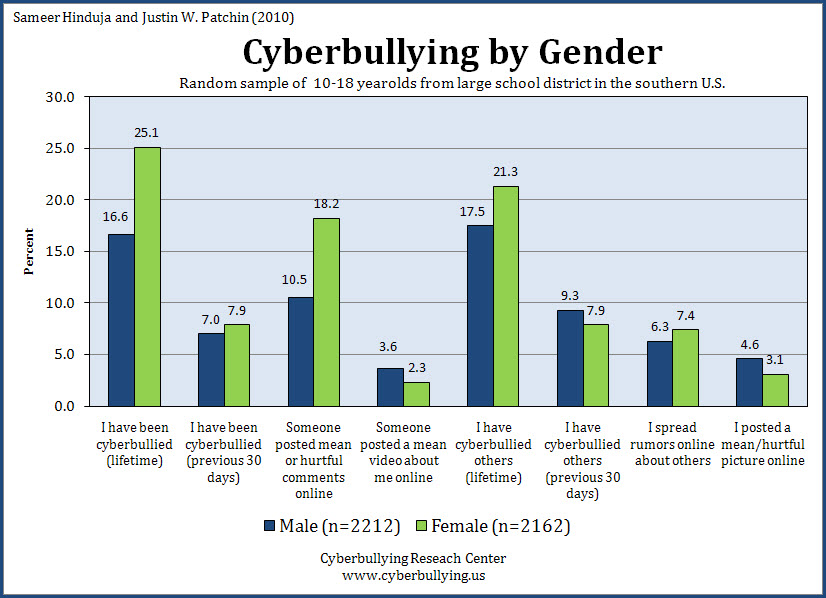
Recently, we discussed the issues regarding teens and technology, among which cyber-bullying was mentioned. Cyber-bullying has become a big issue among children and teenagers in recent years. "Cyber-bullying is when someone repeatedly harasses, mistreats, or makes fun of another person online or while using cell phones or other electronic devices." Specific types of cyber-bullying found in studies are: mean or hurtful comments (13.7%) and rumors spread (12.9%) online continue to be among the most commonly-cited. Data shows that the higher amount of victims are females. This means that girls, both teenage or younger, are more likely to be bullied online than their male counterparts. (Hinduja & Patchim, 2010)
Now, let’s look at a cyber-bullying phenomenon: Girl-on-girl cyber-bullying.
A new issue has been observed more recently at schools and neighborhoods, as “[t]he type of cyber-bullying tends to differ by gender; girls are more likely to spread rumors while boys are more likely to post hurtful pictures or videos.” (Cyber-bullying Research Center, 2010)
Mental health professionals are now starting to observe girl-on-girl cyber-bullying situations, where as before -in the non electronic era- it was mostly done directly, by girl cliques against their socially weaker victim. In these new cases the use of media has provided for easier ways to do this:
Now, let’s look at a cyber-bullying phenomenon: Girl-on-girl cyber-bullying.
A new issue has been observed more recently at schools and neighborhoods, as “[t]he type of cyber-bullying tends to differ by gender; girls are more likely to spread rumors while boys are more likely to post hurtful pictures or videos.” (Cyber-bullying Research Center, 2010)
Mental health professionals are now starting to observe girl-on-girl cyber-bullying situations, where as before -in the non electronic era- it was mostly done directly, by girl cliques against their socially weaker victim. In these new cases the use of media has provided for easier ways to do this:


)